Relative Clauses / Valme's English Corner: 3º ESO Relative Clauses: Defining .... A relative clause is typically a clause that modifies a noun or noun phrase, and uses some grammatical device to indicate that one of the arguments within the relative clause has the same referent as that noun or noun phrase. We can't drop the relative pronoun in this kind of clause, even if the relative pronoun is the subject of the clause. A relative clause can be used to give additional information about a noun. The information may be quite interesting and important to the larger conversation, but it is not essential for precise identification of the noun. Relative clauses give us information about the person or thing mentioned.
The woman who lives next door works in a bank. Defining relative clauses (also called identifying relative clauses or restrictive relative clauses) give detailed information defining a general term or expression. However, a preposition may also start it off when we need to express our ideas more formally. The relative clause modifies the plural noun "students." the word "who" is the subject of the relative clause and "were" is the verb. A relative clause can be introduced by either a relative pronoun or a relative adverb.
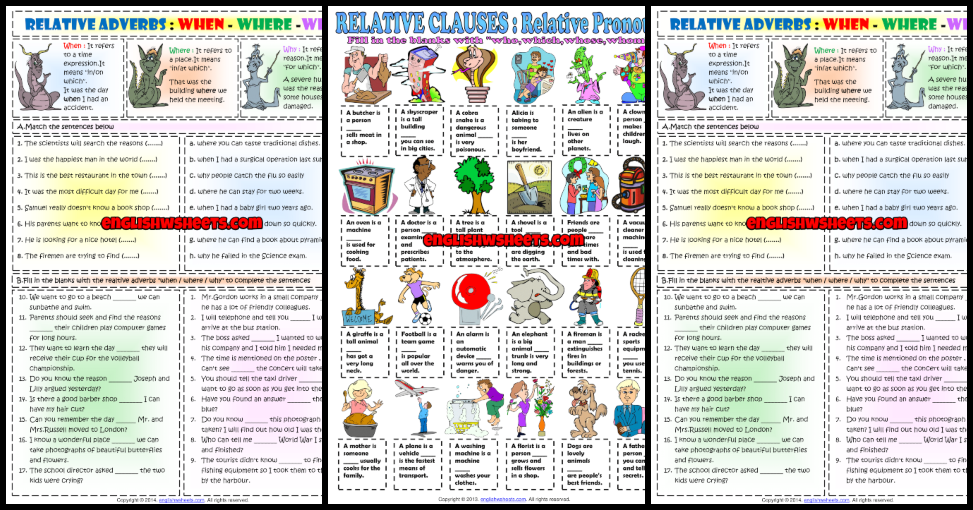
Relative Clauses ESL Printable Worksheets and Exercises from www.englishwsheets.com "it was an experience that influenced my career choice." in this sentence, the relative pronoun "that" introduces the relative clause "that influenced my The information may be quite interesting and important to the larger conversation, but it is not essential for precise identification of the noun. Imagine, tom is in a room with five girls. However, a preposition may also start it off when we need to express our ideas more formally. The following is another example: Jan 27, 2021 · a relative clause is generally introduced by a relative pronoun in colloquial english. A relative clause can be introduced by either a relative pronoun or a relative adverb. We can't drop the relative pronoun in this kind of clause, even if the relative pronoun is the subject of the clause.
Defining relative clauses (also called identifying relative clauses or restrictive relative clauses) give detailed information defining a general term or expression.
This type of relative clause merely provides extra information. However, a preposition may also start it off when we need to express our ideas more formally. Defining relative clauses are not put in commas. "it was an experience that influenced my career choice." in this sentence, the relative pronoun "that" introduces the relative clause "that influenced my We can't drop the relative pronoun in this kind of clause, even if the relative pronoun is the subject of the clause. A relative clause can be restrictive or nonrestrictive (essential or nonessential) restrictive relative clauses restrict or define the meaning of a noun and are not set apart by commas. Defining relative clauses (also called identifying relative clauses or restrictive relative clauses) give detailed information defining a general term or expression. The relative clause modifies the plural noun "students." the word "who" is the subject of the relative clause and "were" is the verb. Jan 27, 2021 · a relative clause is generally introduced by a relative pronoun in colloquial english. The following is another example: A relative clause is typically a clause that modifies a noun or noun phrase, and uses some grammatical device to indicate that one of the arguments within the relative clause has the same referent as that noun or noun phrase. Imagine, tom is in a room with five girls. Relative clauses which give extra information, as in the example sentences above, must be separated off by commas.
Jan 27, 2021 · a relative clause is generally introduced by a relative pronoun in colloquial english. However, a preposition may also start it off when we need to express our ideas more formally. "it was an experience that influenced my career choice." in this sentence, the relative pronoun "that" introduces the relative clause "that influenced my A relative clause is typically a clause that modifies a noun or noun phrase, and uses some grammatical device to indicate that one of the arguments within the relative clause has the same referent as that noun or noun phrase. Neil armstrong, that was born in 1930, was the first man to stand on the moon.
English Intermediate I: U7:Relative clauses from 2.bp.blogspot.com A relative clause is typically a clause that modifies a noun or noun phrase, and uses some grammatical device to indicate that one of the arguments within the relative clause has the same referent as that noun or noun phrase. A relative clause can be used to give additional information about a noun. The information may be quite interesting and important to the larger conversation, but it is not essential for precise identification of the noun. Jan 27, 2021 · a relative clause is generally introduced by a relative pronoun in colloquial english. Defining relative clauses are not put in commas. "it was an experience that influenced my career choice." in this sentence, the relative pronoun "that" introduces the relative clause "that influenced my Relative clauses give us information about the person or thing mentioned. This type of relative clause merely provides extra information.
The following is another example:
The woman who lives next door works in a bank. Neil armstrong, that was born in 1930, was the first man to stand on the moon. Defining relative clauses are not put in commas. "it was an experience that influenced my career choice." in this sentence, the relative pronoun "that" introduces the relative clause "that influenced my A relative clause is typically a clause that modifies a noun or noun phrase, and uses some grammatical device to indicate that one of the arguments within the relative clause has the same referent as that noun or noun phrase. A relative clause can be introduced by either a relative pronoun or a relative adverb. A relative clause can be restrictive or nonrestrictive (essential or nonessential) restrictive relative clauses restrict or define the meaning of a noun and are not set apart by commas. However, a preposition may also start it off when we need to express our ideas more formally. Relative clauses give us information about the person or thing mentioned. Imagine, tom is in a room with five girls. Relative clauses which give extra information, as in the example sentences above, must be separated off by commas. The relative clause modifies the plural noun "students." the word "who" is the subject of the relative clause and "were" is the verb. (clause comes after the subject)
A relative clause is typically a clause that modifies a noun or noun phrase, and uses some grammatical device to indicate that one of the arguments within the relative clause has the same referent as that noun or noun phrase. However, a preposition may also start it off when we need to express our ideas more formally. Defining relative clauses (also called identifying relative clauses or restrictive relative clauses) give detailed information defining a general term or expression. The woman who lives next door works in a bank. A relative clause can be introduced by either a relative pronoun or a relative adverb.
RELATIVE PRONOUNS - English ESL Worksheets for distance ... from en.islcollective.com However, a preposition may also start it off when we need to express our ideas more formally. This type of relative clause merely provides extra information. Defining relative clauses are not put in commas. A relative clause can be introduced by either a relative pronoun or a relative adverb. "it was an experience that influenced my career choice." in this sentence, the relative pronoun "that" introduces the relative clause "that influenced my The following is another example: The information may be quite interesting and important to the larger conversation, but it is not essential for precise identification of the noun. The relative clause modifies the plural noun "students." the word "who" is the subject of the relative clause and "were" is the verb.
Defining relative clauses are not put in commas.
"it was an experience that influenced my career choice." in this sentence, the relative pronoun "that" introduces the relative clause "that influenced my Jan 27, 2021 · a relative clause is generally introduced by a relative pronoun in colloquial english. Relative clauses give us information about the person or thing mentioned. The following is another example: A relative clause is typically a clause that modifies a noun or noun phrase, and uses some grammatical device to indicate that one of the arguments within the relative clause has the same referent as that noun or noun phrase. Relative clauses which give extra information, as in the example sentences above, must be separated off by commas. A relative clause can be introduced by either a relative pronoun or a relative adverb. However, a preposition may also start it off when we need to express our ideas more formally. (clause comes after the subject) They are introduced by a relative pronoun like 'that', 'which', 'who', 'whose', 'where' and 'when'. Defining relative clauses (also called identifying relative clauses or restrictive relative clauses) give detailed information defining a general term or expression. A relative clause can be used to give additional information about a noun. This type of relative clause merely provides extra information.